
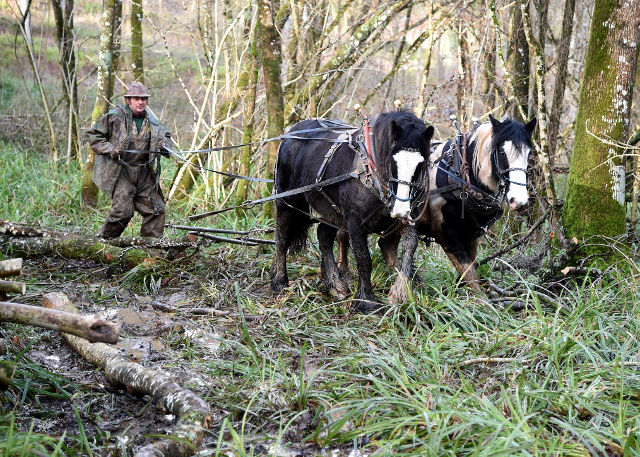
Working horses were in action this week at the Prime Coppice woodland in the Marshwood Vale. The two heavy cob type horses, Holly and Ivy, together with Crunchie the Hereford based Horse logger were pulling out freshly felled Ash, Oak and Alder that will then be processed into firewood and sawn into planks and beams. Members of the public were able to come and see the horses in action on Saturday the 10th, witnessing some large trees being felled and learning about the pros and cons of using horses for woodland work. Participants shared ideas and information amongst themselves and were amazed at how quickly and efficiently the horses were able to extract the wood.
Prime coppice is a semi-natural ancient woodland and has a long history as a working wood, having been coppiced for hundreds of years and managed for a range of products, but it has not been actively managed for the last 30 years. We are working to restore the woodland, bringing the coppice back into rotation, opening up the woodland rides and tracks and increasing the wildlife through careful management. Much of the wood is Hazel and Ash coppice with some large Oak trees. The horses were an essential part of a team that were coppicing the Hazel and Ash and extracting some of the overstood Oak trees. Coppicing is an ancient woodland management method where a tree is felled at ground level and then regrows over a period of years without needing to be replanted. Coppice products are used for many things including hurdles, pea and bean sticks and other craft uses plus charcoal and firewood. Coppicing is very good for the woodland and its wildlife, with birds, insects and wild flowers all benefiting from managed intervention. Coppiced trees don’t grow well if it is shaded out by larger trees, so some of the large Oak trees were being felled to give the coppice a new lease of life with regeneration and new plantings of Oak and hazel to follow.
Using horses has a much smaller impact on the ground than using tractors and machinery, and working horses are ideally suited to steep sites, wet sites and environmentally sensitive areas. It also reduces compaction and damage to the woodland floor whilst giving no pollution from fossil fuels !
People have been working woods with horses for many generations. We have found horse shoes of all sizes and shapes in the wood and around the barns, so its nice to have that history and to have them back after a break of probably 80 years or more. The harvesting of our coppice trees is an example of actively regenerating our woodlands for multiple benefits for the local economy, wildlife and community.
Recent Comments